
Choosing between a passenger lift and a goods lift is a critical operational decision for any business. While both systems move vertically, their engineering logic, safety standards, load capacity, and compliance requirements are fundamentally different. Selecting the wrong type can lead to safety violations, accelerated wear, regulatory penalties, and unnecessary costs.
This commercial elevator selection guide explains the difference between passenger and goods lift systems so business owners, developers, and facility managers can confidently decide which lift is best for business operations today and future growth.
Purpose and Typical Use Cases
The most important distinction in the passenger lift vs goods lift debate is purpose.
Passenger elevator
- Designed exclusively for transporting people
- Optimized for comfort, smooth acceleration, and aesthetics
- Common in offices, hotels, malls, hospitals, and residential towers
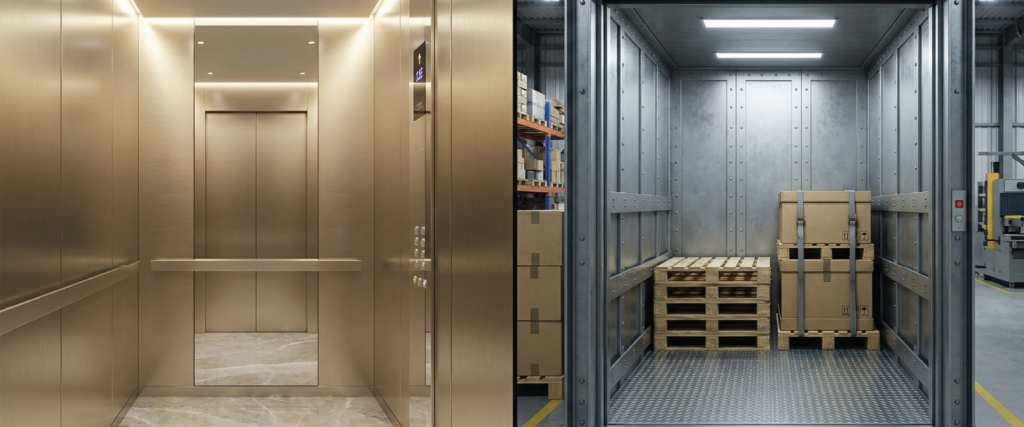
Passenger elevators are engineered around human comfort and experience. The acceleration curve is calibrated to avoid jerks, vibration levels are minimized, and interiors are finished with premium materials to enhance the building’s image. In commercial properties, the passenger elevator becomes part of the brand perception. A smooth and quiet ride signals professionalism and quality infrastructure.
Because they are built for human traffic patterns, passenger lifts are also optimized for peak-hour flow management, especially in office buildings and hospitality environments.
Goods lift / industrial goods lift
- Designed for transporting materials, pallets, equipment, and inventory
- Built for durability and impact resistance
- Used in warehouses, factories, logistics hubs, and service areas
Goods lifts are engineered with a completely different operational logic. Instead of prioritizing aesthetics, they focus on structural strength, reinforced cabins, and high load-bearing capability. The floor plates are built to handle concentrated weight, such as pallet wheels or machinery legs, which would damage a standard passenger lift floor.
In industrial environments, durability and reliability matter more than ride comfort. Goods lifts are therefore designed to withstand repetitive heavy loading without compromising structural integrity.
Using a passenger elevator for freight is a common mistake that leads to premature failure and expensive downtime.
Design and Safety Features
The engineering and safety systems differ significantly between the two lift types.
Passenger elevators
- Refined cabin finishes
- Advanced door sensors and safety edges
- Smooth ride quality and noise control
- Sophisticated control systems
Passenger elevators are equipped with advanced door safety mechanisms such as infrared sensors and auto-reopen features to protect passengers. The ride system is calibrated for smooth start and stop transitions, reducing discomfort. Noise insulation and vibration dampening systems are also integrated to maintain a premium experience.
Control panels often include intelligent dispatch systems that optimize travel efficiency in multi-lift buildings.
Goods lifts
- Reinforced cabins and floors
- Manual or heavy-duty automatic doors
- Minimal interior finishing
- Safety systems designed for load stability, not comfort
Goods lifts use thicker steel panels and reinforced frames to resist impact damage. Doors are typically side-opening or collapsible gates capable of handling industrial wear. Instead of comfort-focused safety systems, goods lifts prioritize load stability, anti-sway control, and braking systems designed to handle high torque under heavy loads.
This design difference explains why freight elevator vs passenger elevator misuse causes frequent breakdowns and structural damage.
Load Capacity and Performance Differences
Load handling is one of the most critical differentiators.
Passenger elevator load range: lower, optimized for people
Passenger lifts are designed for evenly distributed human weight. While they can handle a specific rated capacity, that capacity assumes distributed loading—not concentrated heavy objects. Exceeding weight limits or introducing uneven loads stresses the traction system and suspension components.
Goods lift load range: significantly higher for pallets and machinery
Goods lifts are built for substantially higher weight thresholds. They are capable of handling heavy pallets, machinery, and stacked inventory without compromising structural integrity.
Passenger lifts prioritize speed and ride smoothness
Speed is a performance metric in commercial passenger environments. Faster vertical movement improves traffic flow and reduces waiting time.
Goods lifts prioritize torque, durability, and load control
Goods lifts operate at lower speeds but with stronger lifting motors and enhanced torque capacity. Stability under load is more important than travel speed.
Repeated overloading is one of the fastest ways to destroy a passenger elevator’s mechanical system.
Compliance and Regulatory Considerations
Safety codes clearly define usage limits:
- Passenger elevators cannot legally replace goods lifts
- Freight transport in passenger lifts violates lift safety regulations
- Inspections may fail if misuse is identified
- Compliance alone makes correct commercial lift type selection essential
Elevator safety authorities classify lifts based on intended usage. Passenger elevators are certified for human transportation only. Using them for freight movement may violate building safety regulations and insurance terms.
In many regions, safety audits include usage evaluation. If inspectors identify misuse, building owners may face penalties, liability exposure, or forced system upgrades.
Compliance is not just a technical matter—it is a legal and financial safeguard.
Cost Comparison: Installation and Maintenance
Cost evaluation must go beyond initial installation price.
Passenger elevators
- Higher aesthetic cost
- Moderate maintenance cost
- Sensitive to misuse
Passenger elevators require investment in cabin finishing, lighting, control panels, and decorative elements. Maintenance costs remain predictable when the system is used correctly. However, misuse significantly increases wear and tear, leading to higher repair expenses.
Goods lifts
- Higher civil and structural cost
- Lower aesthetic expense
- Longer service life under heavy loads
Goods lifts may require reinforced shafts and structural support due to higher weight ratings. While they lack premium interior finishes, their industrial build quality often translates into longer operational life under heavy-duty usage.
Choosing the wrong lift type increases total ownership cost—not reduces it. Initial savings often convert into long-term repair liabilities.
How to Choose the Right Lift for Your Business
Use this framework:
- Offices/hotels/hospitals → Passenger elevator
- Warehouses/factories → Goods lift
- Mixed-use buildings → Separate passenger and goods lifts
If your building handles both people and material movement, installing separate systems is the most efficient solution. This separation prevents congestion, protects equipment life, and ensures compliance.
Correct selection protects safety, regulatory compliance, workflow efficiency, and long-term capital investment. The right elevator is not just infrastructure—it is operational strategy.